
Multi-vendor marketplace with AI personalisation and cross-border payments
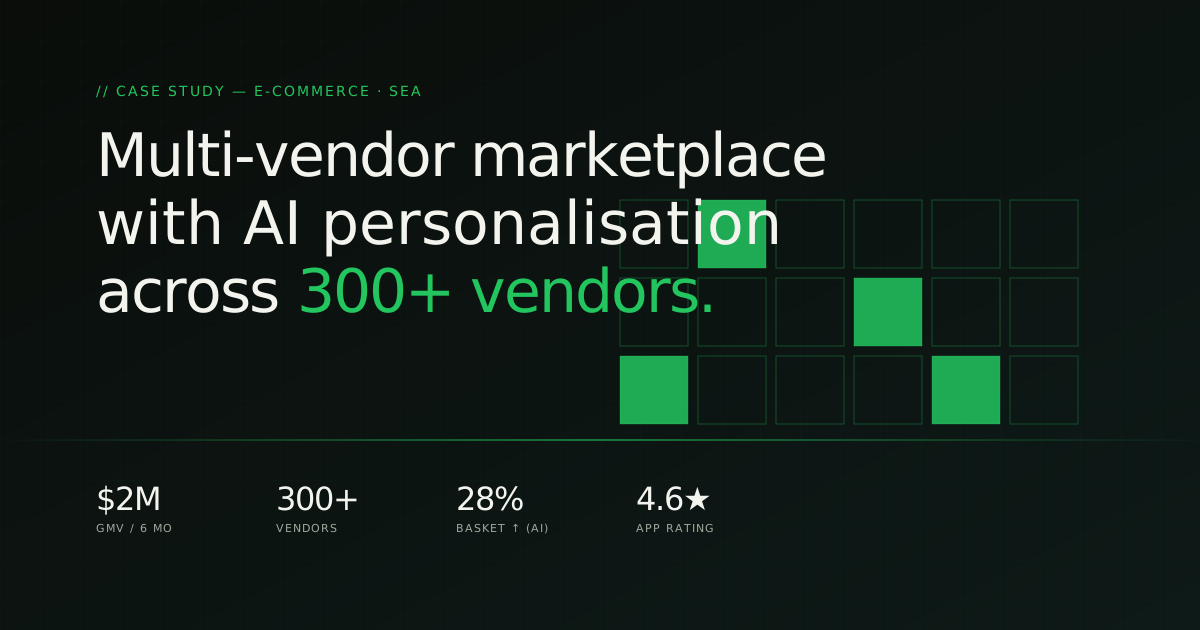
A retail entrepreneur wanted a Southeast Asian marketplace for artisan brands — 300+ vendors, multi-currency checkout, local logistics, and AI personalisation from day one. We shipped a Laravel + React.js stack with Stripe Connect that crossed $2M GMV in 6 months and lifted basket size 28% via AI recommendations.
The challenge
A retail entrepreneur saw an opening in Southeast Asia: artisan and small-batch brands with no scalable storefront, customers underserved by global marketplaces, and logistics that needed to respect 11 country borders. They needed:
- 300+ vendor onboarding — fast, self-serve, with verification gating
- Multi-currency checkout across 8 currencies with cross-border payouts
- Local logistics integrations across SEA carriers and customs brokers
- AI personalisation from launch — not a “v2 maybe” — because the long-tail SKU mix demanded it
Off-the-shelf marketplace platforms either couldn’t handle the cross-border money flow or buried personalisation behind opaque algorithms.
What we built
A custom marketplace with built-in AI surfacing:
- Vendor onboarding portal with KYC, payout setup, listing tooling, and analytics
- Multi-vendor cart that handles split shipments, split payments, and per-vendor returns
- Stripe Connect for multi-party payments across 8 currencies, including delayed payouts and dispute handling
- AI recommendation engine using browsing behaviour, purchase history, and product embeddings — surfaces under-discovered SKUs
- Real-time inventory sync across vendor stores so over-selling becomes mathematically impossible
- Companion mobile apps for buyers (browse, checkout, track) and vendors (orders, payouts, listings)
AI recommendations lifted average basket size by 28% in the first three months.
Architecture
A Laravel + React.js stack on AWS, with a vendor-first data model:
- Backend: Laravel API with vendor-scoped tenancy, queued payout reconciliation, idempotent webhook processing
- Frontend: React.js storefront with edge-cached product pages and personalised home grids
- Mobile: React Native apps for buyer and vendor flows, offline order queue
- Payments: Stripe Connect for multi-party flow; reconciliation jobs handle payout sweeps + currency hedging
- AI/ML: OpenAI embeddings for product similarity + a lightweight collaborative filter for personalisation
- Logistics: Carrier API layer behind a uniform interface — swap carriers without touching checkout
Outcomes
- $2M GMV crossed at 6 months post-launch
- 300+ vendors actively trading
- 28% lift in average basket size attributable to AI recommendations
- 4.6★ app rating across buyer and vendor apps
- Sub-1-day vendor onboarding median
- Zero cross-border payout incidents in the first year
Why it worked
Three calls shaped the outcome:
- AI from launch, not a future v2. The marketplace’s edge was discoverability — that meant recommendations had to ship at v1. Embedding-based similarity was simple enough to ship in week 6 and good enough to drive 28% basket lift.
- Cross-border money flow as a first-class problem. The hard work wasn’t the storefront; it was reconciliation across 8 currencies and 11 jurisdictions. We built the payout engine before the listings page.
- Mobile-first, both sides. Vendors run shops from their phones. Buyers shop from their phones. Both apps shipped at launch with full feature parity to the web.
The marketplace is now expanding to a second region with the same platform, no rewrites required.